FAQ –Sterilization in the medical field and color intelligence
- How can a smart material guarantee compliance with a sterilization cycle?
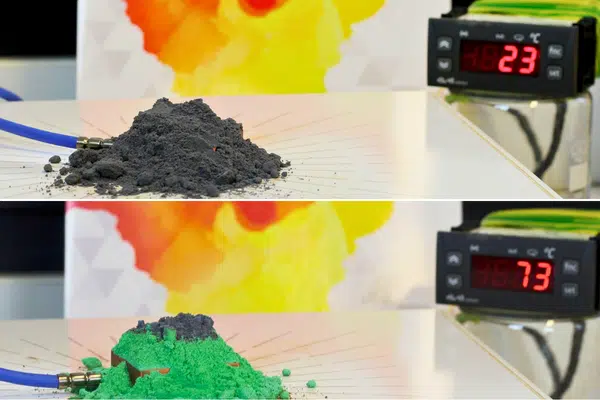
A smart material alone does not "guarantee" regulatory compliance for a cycle, but it acts as an integrated visual indicator. Thanks to calibrated thermochromic or chemochromic pigments, the color change only occurs when a specific threshold is reached (temperature, chemical atmosphere, humidity, or combination of parameters). It is a complement to existing protocols, not a substitute for normative validations.
- Are smart pigments compatible with medical biocompatibility requirements?
Yes, provided they are specifically formulated for this use. Integration into a medical environment requires controlled encapsulation, no migration, compatibility with medical polymer matrices, and compliance with the regulatory requirements applicable to the devices concerned. The development of suitable solutions is based on a tailor-made formulation approach, taking into account regulatory and industrial constraints.
- Can the color change be irreversible?
Absolutely. Depending on the application, the system can be reversible, for devices subject to repeated cycles, or irreversible, to provide permanent visual proof of compliant exposure. In the medical field, irreversible systems are particularly relevant for validating a single cycle or detecting a break in the cold chain.
- Can smart materials replace traditional sterilization indicators?
No, and that is not their purpose. Smart materials are an integrated visual indicator and a tool for operational simplification. They complement existing biological, chemical, and digital controls by providing immediately accessible information without the need for instrumentation. Their value lies in their ability to transform the surface of the device into a passive, autonomous sensor.